Where can’t you scatter ashes in the UK?
Last checked: September 2026. Policies change, so please confirm with the landowner before you go.
Most people assume that scattering ashes is something you can quietly do anywhere, as long as you’re respectful about it. For the most part that’s true. There’s no single law in England and Wales that says where ashes may or may not go.
But there are places where the answer is a flat no, and some of them will surprise you. The clearest example covers more land than any other organisation in England manages, and the organisation itself has confirmed to us that the policy isn’t published anywhere a grieving family would think to look.
This guide sets out where you can’t scatter, where you’ll probably be told no, and where you simply need to ask first.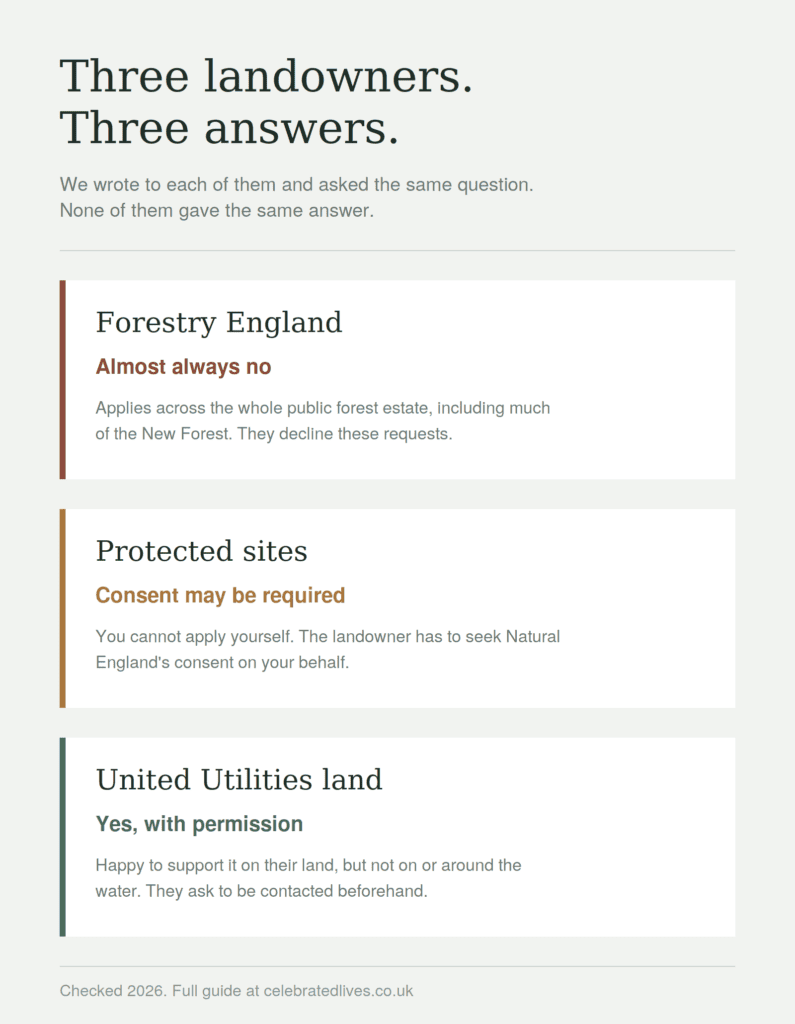
First, three words that get mixed up
Families tend to use “scattering” to mean everything you might do with ashes. Landowners and funeral professionals use these words to mean quite different things, and it matters, because a place that says no to one may say yes to another.
Scattering means tipping the ashes out so they disperse across the ground, or into water. Nothing is buried. Nothing is left behind.
Interring means placing the ashes into the ground, usually still in a container, in a small dug hole. Sometimes called burying ashes.
Strewing is the older, formal term for scattering, and it’s the one you’ll see in church and cemetery paperwork.
Why this matters: some places allow scattering but not interring, because they don’t want holes dug or permanent spots created. Others allow interring but not scattering, because loose ashes across a maintained lawn or grave cause them problems. The Commonwealth War Graves Commission is a good example of the second. So if you get told no, it’s always worth asking whether the other option is available.
Being allowed to walk somewhere isn’t the same as being allowed to scatter
This is the thing that catches most people out, and it’s worth saying plainly before you read the rest.
Plenty of the places in this guide are open to the public. Forestry England’s forests are free to visit all year round. United Utilities actively encourage people onto their land and run recreation sites on it. National Trust properties are visited by millions.
None of that settles the question. Every organisation we spoke to treats access and scattering as two separate things. Forestry England welcome you into their woods and still decline scattering requests. United Utilities are happy for you to be there and happy for you to scatter, but want to be asked first so they know where it’s happening. Being welcome to walk somewhere doesn’t carry a decision about what you leave behind.
It’s a reasonable position when you think about it from their side. One family’s ashes make no difference to anything. It’s the accumulation, in the same handful of beautiful places, that changes soil and creates a spot people return to and want marked.
So the question is never “is this place public?” It’s “who owns this ground, and what do they say?”
Where Can’t You Scatter Ashes in the UK?
Forestry England forests
This is the big one, and almost nobody knows about it.
Forestry England’s published guidance states that it is not possible to scatter ashes in their forests. We contacted them to check what that means in practice, and they confirmed their position directly. A spokesperson for Forestry England told us:
“We mostly decline requests to scatter ashes because they can alter the chemistry of the soil and upset its natural balance, causing harm to the forest and the wider wildlife habitats.”
They confirmed three things for us in August 2026.
It covers everything they manage. The position applies across the whole public forest estate, not just the areas around dedication benches. Forestry England look after more land and more trees than any other organisation in England, so this covers a very large number of the woodlands families think of first.
It’s a strong position rather than an absolute rule. Forestry England told us this is a position rather than a rule applied identically everywhere, but that families shouldn’t expect scattering to be something they can generally accommodate. In plain terms: you can ask, and you will almost certainly be told no.
It isn’t published anywhere obvious. Forestry England confirmed that at present this appears nowhere on their website other than the bench dedication FAQ, and said it was a fair point and something they may look at improving. That’s worth knowing, because it means a family can search for this in good faith and never find it.
The New Forest is the clearest example. Forestry England manage 47% of the New Forest National Park, including much of the best known ancient woodland, heathland and wetland. So if you were picturing an ancient oak in the New Forest, that’s very likely land where you’d be turned down. 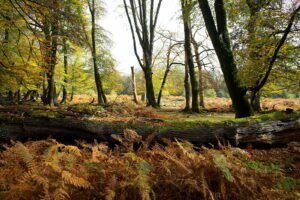
One thing worth being clear about: this doesn’t mean a whole national park is off limits, because Forestry England don’t own all of it. It’s about who holds the particular piece of ground, not what the area is called.
Forestry England confirms this in its dedication benches FAQ, last updated 29 May 2025 (live page / archived 6 September 2026).
The Royal Parks
The eight Royal Parks are Bushy Park, Green Park, Greenwich Park, Hyde Park, Kensington Gardens, Regent’s Park with Primrose Hill, Richmond Park and St James’s Park.
Their published policy is a clear presumption against. Their reasoning is that ashes contain minerals in concentrations that affect the soil and the plants growing in it, which in turn affects the wildlife relying on those plants for food and shelter. Richmond Council’s own parks guidance separately notes that the Royal Parks within their borough sit outside council rules.
It isn’t quite an absolute ban, though. The policy says that in exceptional circumstances, defined areas in some of the Royal Parks may be made available, at the discretion of the Park Manager. So there is a route, it’s just narrow and it starts with a conversation.
They do offer alternatives, including a Garden of Remembrance and ashes plots at Brompton Cemetery, which they manage.
Ancient woodland
The Woodland Trust are direct about it. They cannot permit ash scattering in ancient woodland or other sensitive habitats, because ashes change soil chemistry and damage fragile ecosystems that are home to rare and vulnerable species.
This one comes with good news attached, though. They have many woods that aren’t classed as ancient or sensitive where they’re happy for ashes to be scattered carefully, they don’t charge for it, and they ask you to contact them so they can help you find the right wood. Tell them the region or the name of the wood you have in mind.
At a war grave
The Commonwealth War Graves Commission allow ashes to be interred, but scattering at the grave is not permitted.
This is exactly the distinction from earlier. If a relative is commemorated at a CWGC site, the door isn’t closed, it’s just a different door.
Football grounds
The idea of a lifelong supporter’s ashes going onto the pitch is a powerful one, and it used to happen. It’s now rare.
Two reasons. The mineral content of ashes damages what are now highly engineered playing surfaces, and large clubs receive so many requests that they simply can’t manage them.
Positions vary and change, so check with your club directly, but among clubs that have said no in recent years are Chelsea, West Ham, Burnley, Bristol City, Brighton, Bournemouth, Wigan, West Bromwich Albion and Wembley Stadium. Several have memorial gardens instead, though some of those are now full. Reading closed their under-pitch burials and opened a garden of remembrance after demand outgrew what they could handle.
If your club says no, ask about a memorial garden, a plaque, or a dedicated brick. Most have something.
Certain heritage properties and monuments
There’s no single heritage rule, but individual properties set their own and some are firm nos. Jane Austen’s House don’t allow it. The trust that runs the Shakespeare properties in Stratford-upon-Avon don’t allow it at any of their sites. Scheduled monuments, Stonehenge included, are a no, and formal consent would be required in any case.
Cadw in Wales and Historic Environment Scotland both operate written request processes rather than blanket refusals, so it’s worth asking.
Places where you’ll be strongly discouraged
These aren’t always outright bans, but the conservation case against is serious and you should think hard before going ahead.
Mountain summits
Snowdon, or Yr Wyddfa, is the clearest case. The national park authority ask people to avoid scattering there, because ashes alter the soil’s naturally low pH and encourage non-native vegetation to move in. Much of the mountain is designated as a Site of Special Scientific Interest or a National Nature Reserve, which brings the protected site rules below into play as well. Memorials and plaques left on the summit are removed. 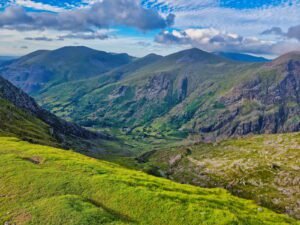
The same argument applies across the Lake District fells. The British Mountaineering Council point out that added nutrients allow common grasses to outcompete the rare high-mountain plants that survive precisely because the soil is poor. Scafell Pike gets specific mention.
The volume is part of the problem. One family’s ashes make no difference. Thousands, in the same handful of famous spots, do.
If a summit really was the place, one option worth considering is scattering lower down the same mountain, somewhere the person actually walked, rather than the cairn at the top.
Places where you need to ask, and will often be told yes
National Trust land
The National Trust don’t operate a formal policy. They consider requests individually and consent can be granted, subject to conditions: no contamination of watercourses, no permanent or temporary markers, done discreetly and privately without affecting others’ enjoyment, and no visible presence of ashes afterwards. Arrangements are made locally with the property manager, so contact the property itself rather than head office.
Nature reserves
RSPB decisions sit with the individual site manager, and the answer is site by site rather than a blanket yes or no. Some reserves can accommodate it, some can’t. Their in-memory team is the starting point.
Council parks and open spaces
This varies enormously by council. Some allow scattering with guidance, some ask you to notify them first, some restrict it to particular areas. Richmond Council, for example, permit scattering under their guidance but do not permit burial or interment of ashes in their parks. Your council’s bereavement services or parks team will know.
Protected sites: SSSIs and National Nature Reserves
Around 8% of England is designated as a Site of Special Scientific Interest, and there are more than 4,000 of them. Nothing on the ground tells you that you’ve walked into one.
We asked Natural England how scattering is treated on protected land, and their Protected Sites team set out the position for us in August 2026.
Scattering ashes on an SSSI may require Natural England’s consent. It falls under a category called ORNEC 7, covering the dumping, spreading or discharging of any materials. Every SSSI has its own list of Operations Requiring Natural England Consent, and those lists differ site to site. Where ORNEC 7 appears on a particular site’s list, consent is needed.
Here’s the part almost nobody knows. You can’t apply for that consent yourself. Natural England told us they can only grant consent to the landowner, the legal occupier, or the public body managing the site. A family has to get the landowner’s permission first, and it’s then the landowner who seeks consent or advice from Natural England on the family’s behalf.
The same applies to National Nature Reserves. The route runs through whoever owns or manages the reserve, not through Natural England directly.
If you want to check a spot properly, Natural England recommend this order:
- Look the location up on the MAGIC map. Tick the layers you want so the designations show, then use the identify tool and click the site.
- From there, go to Designated Sites View, find the SSSI, and open its ORNEC list to see whether ORNEC 7 is listed.
- If it is, find and contact the landowner. Natural England can’t give out landowner details, but you can search property information through HM Land Registry.
That’s a lot of steps for a family who just want to stand somewhere and say goodbye, and we won’t pretend otherwise. But if the place genuinely matters, it’s better to know than to find out afterwards.
In practice, most families scattering discreetly on protected land will never encounter a problem. This is about doing it properly rather than about anyone being pursued.
Water: rivers, lakes, reservoirs and the sea
At sea is the most straightforward option in the UK. You don’t need a licence or permission to scatter ashes at sea after a cremation. That’s different from a burial at sea, which does require a marine licence.
Rivers and lakes are generally fine. The Environment Agency’s guidance, set out in their leaflet on funeral practices and spreading ashes, asks you to scatter more than 1km upstream of any water abstraction point, to keep away from buildings, marinas and anyone bathing or fishing, to spread the ashes as close to the surface of the water as possible, and to avoid windy days. Nothing else should go into the water with them, so no wreaths, personal items or wrappings. If someone owns the bank, you’ll still need their permission to stand on it.
Reservoirs are worth pausing on. Supply reservoirs are themselves abstraction points for drinking water, which means the 1km guidance points against scattering into or immediately around them. Water companies are also very substantial landowners in exactly the scenic places families choose. United Utilities alone manage more than 56,000 hectares of catchment land, making them the largest corporate landowner in England, including the land around Thirlmere and Haweswater in the Lake District.
We asked United Utilities directly, and their answer in September 2026 was more welcoming than you might expect. They told us they have no policy they’re aware of covering scattering, that they consider it a relatively low-risk activity, and that they are happy to support it taking place on their land. Two conditions come with that. They ask that it isn’t carried out on or around the water, and they ask that permission is sought beforehand, so they can keep an eye on it and make sure it doesn’t become too significant in any one location.
That second condition matters. Their willingness depends on knowing where and how often it’s happening, so asking first isn’t red tape, it’s the reason the answer is yes. Contact them before you go.
Two further things worth knowing about their land. A good deal of it is tenanted to farmers, and around 30% of it is designated as a Site of Special Scientific Interest, which may bring the protected site process described above into play as well. So it’s still worth being specific about the exact spot when you contact them.
Other water companies are likely to take their own view. Yorkshire Water is the other very large landholder in the Pennines. If you’re considering a reservoir outside the North West, ask the relevant company rather than assuming this position applies.
How to find out who owns the land
This is the question underneath every other question, and it catches people out constantly.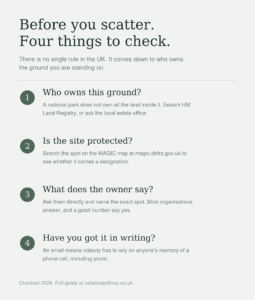
A national park authority usually owns only a small share of the land inside its boundary. The rest belongs to private owners, the National Trust, Forestry England, water companies and others. So asking the national park is often asking the wrong body. They’ll usually be able to point you at the right one, which is still useful.
To find an owner: search property information through HM Land Registry, or check local land charges. For open countryside, the local estate office or park authority is often the fastest route to a straight answer.
If it’s your own garden and you own the property, you don’t need anyone’s permission at all.
If the answer is no
Being told no about a place that mattered is a horrible thing to hear on top of everything else. It isn’t the end of it.
There are more ways to hold onto someone now than there have ever been. Ashes can go into memorial jewellery you wear every day, into hand-blown glass, into a tree planted somewhere you can visit. They can be scattered from the air, or at sea. They can go into a memorial diamond. There are eco memorials and natural burial grounds designed for exactly this, and they’ll welcome you rather than turn you away.
Celebrated Lives is a free directory of UK businesses offering all of these. We don’t sell anything and we’re not owned by a funeral company. Browse by county or by the kind of memorial you have in mind.
A note on accuracy
Policies change, and organisations sometimes update their guidance without announcing it. Everything above was checked in August 2026 against the organisation’s own published wording wherever possible.
Forestry England’s position was confirmed to us in writing by their national office in August 2026, and the quotation above is used with their permission. The protected sites guidance was provided to us by Natural England’s Protected Sites team in August 2026. United Utilities confirmed their position in writing in September 2026, following a telephone discussion and a referral to their water quality team.
Please treat this as a starting point for a phone call, not a substitute for one. A five minute conversation with the landowner is always worth it, and in our experience most people say yes.
If you spot something here that’s out of date, or you’ve had a different answer from an organisation we’ve listed, please [get in touch] and we’ll update it.