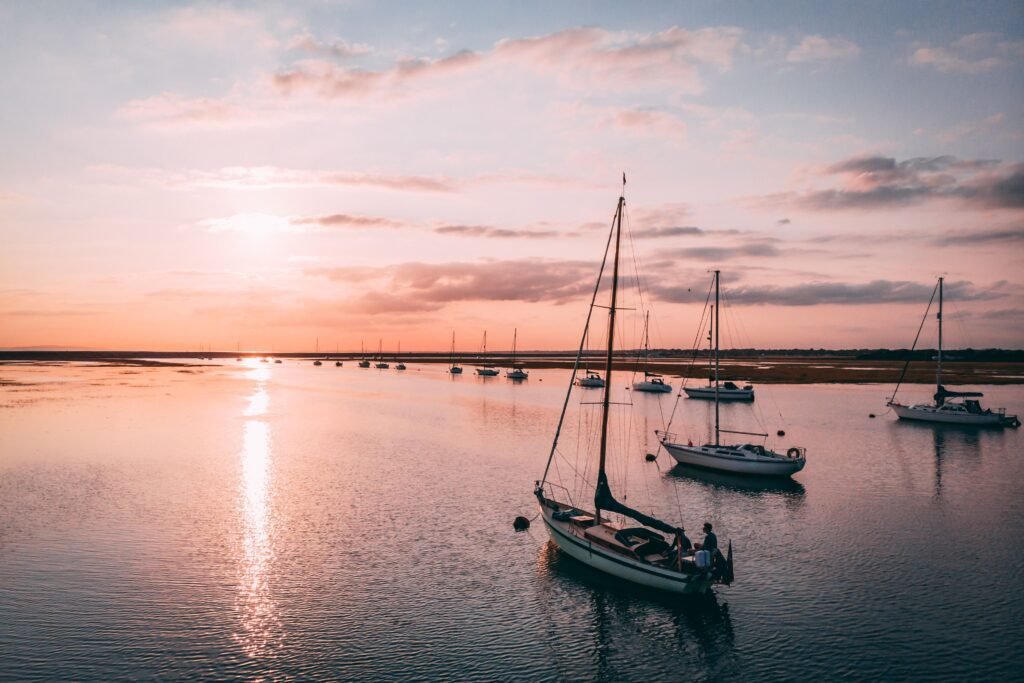
Everything you need to know about scattering ashes at sea in the UK, including the rules, costs, Environment Agency guidance and how to arrange a boat.
For families with a connection to the coast, scattering ashes at sea can be one of the most meaningful ways to say goodbye. Whether your loved one was a sailor, a
fisherman, or simply someone who felt at home by the water, scattering ashes at sea offers a peaceful and personal farewell.

But before you plan the ceremony, most families have the same questions. Is it legal? Do you need permission? How much does it cost? And how do you actually arrange it?
This guide covers everything you need to know about scattering ashes at sea in the UK, including the rules, the costs, and how to find a boat operator near you.
Is it legal to scatter ashes at sea in the UK?
Yes, completely legal, and no licence or permission is needed anywhere in the UK. This is different from a full body burial at sea, which is heavily regulated by the Marine Management Organisation. For the complete legal picture, including land, church ground and more, see our full guide: Is It Legal to Scatter Ashes in the UK?
Scattering ashes is not the same as burial at sea
This is where a lot of confusion comes from, so it’s worth being clear.
Scattering ashes at sea means releasing cremated remains into the water. No licence is needed, and it can be done almost anywhere around the UK coast.
Burial at sea means committing a full body to the sea. This is heavily regulated. It requires a licence from the Marine Management Organisation (MMO), currently costing £175, along with medical certificates and specific coffin requirements. Full body burials are only permitted at three designated sites in England: off The Needles near the Isle of Wight, between Hastings and Newhaven, and off Tynemouth.
If you’re planning to scatter ashes, none of the burial at sea rules apply to you. The MMO itself recommends ash scattering as the simpler alternative, precisely because no licence is needed.
What are the rules for scattering ashes at sea?
While no licence is required, the Environment Agency asks families to follow some common sense guidance to protect the water and other people using it:
Choose a considerate spot. Scatter away from buildings, marinas, moorings, and anywhere people are swimming or fishing.
Scatter close to the water’s surface. This stops ashes being carried on the wind towards other people. Pouring gently from low down, or using a water urn, is the usual approach.
Check the weather. Wind is the biggest practical issue on the day. A gusty day can blow ashes back towards the boat and your guests, which can be distressing. Most boat operators will advise on conditions and offer an alternative date if needed.
Only biodegradable items in the water. Ashes themselves have no harmful effect on water quality, but anything scattered with them must break down naturally. Real flowers and petals are fine. Wreaths with plastic or wire frames, ribbons, and personal items are not.
If you’re scattering on a river, lake or canal rather than the sea, the guidance is similar, with one addition: you should notify the Environment Agency in advance (this is free) and choose a spot at least one kilometre upstream of any point where water is extracted. the full rules on scattering ashes in the UK
Can you scatter ashes on a beach in the UK?
Yes, in almost all cases. You don’t need a licence or written permission to scatter ashes on a beach in the UK, and most families who do it never speak to anyone official at all. There are a few sensible things worth knowing first, though, so you’re not worrying on the day.
Stay below the high tide line. This is the single most useful rule to remember. The strip of sand between the high and low tide marks is called the foreshore, and it isn’t usually owned by the council or by whoever owns the land behind the beach. Across much of England, Wales and Northern Ireland it belongs to the Crown Estate, and in Scotland it’s managed by Crown Estate Scotland. Neither of them asks families to apply for anything to scatter ashes there. Scattering below the high tide line also means the sea does the rest, which is what most people want anyway.
Check whether the beach has byelaws. Some councils set rules for busy or protected beaches, particularly in summer. These are almost never about ashes specifically — they tend to cover barbecues, fires, camping and dogs — but if you’re planning anything beyond scattering, such as lighting a candle, releasing petals or gathering a large group, it’s worth a quick look at the council’s website or a phone call to their beaches team. A short, quiet scattering is very unlikely to trouble anyone.
Think about who else is there. Ashes are heavier and paler than people expect, and they don’t disappear neatly. Early morning, late evening or out of season means you won’t be scattering in front of families with picnics, and you won’t feel rushed. A quieter stretch of the same beach is usually enough.
Watch the wind. Scatter with the wind behind you, low to the ground, and let the ashes fall rather than throwing them. If it’s blowing hard, wait. Standing at the water’s edge on an outgoing tide works well because the water carries them away as they land.
Nothing goes in the sea except the ashes. If you’d like to include flowers, keep them loose and unwrapped, with no cellophane, ribbon, elastic bands or foam. If you’re using a container, it needs to be fully biodegradable — more on that below.
One last thing that catches people out: if the beach is inside a nature reserve, a Site of Special Scientific Interest or a National Trust property, the landowner’s own rules apply on top. A quick call to the site office is all it takes.
How much does it cost to scatter ashes at sea?
The cost of scattering ashes at sea varies widely depending on the boat, location and length of trip.
At the affordable end, a short trip on a small charter boat can cost from around £150 to £250 for an hour. This typically covers a private trip for a small family group, with the skipper taking you to a suitable spot and pausing the boat for the ceremony.
Mid-range trips on larger vessels, or longer ceremonies covering more distance, typically fall between £250 and £500.
Fully managed services on bigger boats, with longer routes, refreshments and added extras like GPS certificates of the scattering location, can run from £1,000 upwards.
Scattering from the shoreline costs nothing at all, though you lose the privacy and sense of occasion that a boat trip provides, and you’re more exposed to wind and tide conditions.
Boat or shoreline: which is better?
Both are perfectly legal, so it comes down to what feels right for your family.
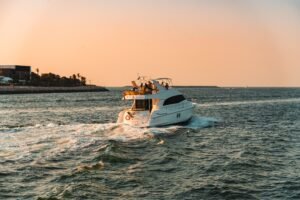 Scattering from a boat offers privacy, calm water away from crowds, and a real sense of ceremony. Many operators will stop the engine at your chosen spot, allow time for words or music, and let family members scatter the ashes and place flowers on the water. Some provide the exact coordinates afterwards, so you can return to the spot on anniversaries.
Scattering from the shore is free, simple, and lets you choose your own timing. If you go this route, pick a quiet time of day, check the tide is going out rather than coming in, stand upwind, and scatter as close to the water as possible.
Where are the best places to scatter ashes at sea in the UK?
There’s no right answer to this, and the best place is nearly always the one that meant something to the person who died — the beach they took you to as a child, the harbour where they kept a boat, the view from the coast path they walked every Sunday. But if you’re starting from a blank page, or you’re scattering somewhere the family doesn’t know well, these are the stretches of coast families choose most often.
The Solent and the South Coast. The water between Hampshire and the Isle of Wight is probably the busiest stretch in the country for scattering ashes, partly because of the sailing history and partly because there are so many boats available. Trips usually leave from Portsmouth, Southampton, Lymington or Poole. It’s sheltered, so it’s a good choice if anyone in the family is nervous about being on the water, and you’re rarely more than half an hour from shore.
The Jurassic Coast and Dorset. Ninety-five miles of cliffs and coves between Exmouth and Studland, and one of the most photographed coastlines in England. Boats go out from Poole, Weymouth and Lyme Regis. Old Harry Rocks and Durdle Door are the landmarks families most often ask for.
Devon and Cornwall. The South West is the other big centre for scattering at sea, with operators working out of Dartmouth, Falmouth, Padstow, St Ives and Fowey. If the person you’re remembering had a connection to fishing, the Navy or the sea in any working sense, this is often where families end up.
Cardigan Bay and the Welsh coast. Quieter than the South West and often cheaper. Dolphins are a genuine possibility off Cardigan Bay in summer, which families frequently mention afterwards as the thing they remember most.
Anglesey and North Wales. Sheltered water, mountain views inland, and easy to reach from the North West of England if travelling any further isn’t practical.
The Mersey and the North West. Scatterings from the Mersey ferries have become a well-established option, and for anyone with Liverpool roots the river carries as much meaning as open sea would.
The Firth of Forth and East Scotland. Trips from South Queensferry pass under the three bridges, which gives the day a natural focal point. The Forth is tidal and open to the sea, so it counts as a sea scattering rather than a river one.
The Northumberland coast. Wide empty beaches, the Farne Islands and Holy Island. If you’d rather scatter from the shore than from a boat, this coast has more genuinely quiet stretches than almost anywhere else in England.
If you’re choosing somewhere you can come back to, think about how easy it will be to reach in ten years’ time. Families often pick a dramatic headland and then find they can’t manage the walk on the anniversary. A spot with a bench, a car park and a decent view is worth more over time than a difficult climb.
Do you need a special urn?
You don’t have to use one, but many families choose a biodegradable water urn, and most boat operators recommend them.
A water urn holds the ashes securely so nothing blows back on a breezy day. Depending on the design, it either floats for a few minutes before gently sinking, giving the family a moment of reflection, or sinks straight away for precise placement. All are made from materials like paper, salt or sand that dissolve harmlessly in the water.
For Hindu and Sikh families, specific urn designs are available, and many UK boat operators are experienced in accommodating religious ceremonies on flowing water.
How to arrange a scattering at sea
- Choose a location. Once you’ve decided on scattering ashes at sea, arranging it is straightforward. This might be somewhere your loved one knew well, or simply a beautiful stretch of coast. Popular locations around the UK include the Solent, the Jurassic Coast, Cornwall, the Firth of Forth, the Mersey, and Cardigan Bay, but boat operators cover almost every part of the coastline.
- Find a boat operator. Look for a company that offers dedicated ash scattering ceremonies rather than general boat hire. They’ll understand the occasion, know the calmest local spots, and handle the practical side so your family can focus on the farewell.
- Plan the ceremony. There are no rules here. Some families keep it silent and simple. Others include readings, music, prayers or a toast. Most trips last between one and two hours.
- Have a weather plan. Sea conditions can change, so agree a backup date with your operator when booking.
- Consider keeping a small amount back. Some families keep a portion of the ashes for memorial jewellery, glass keepsakes or another tribute, so the scattering doesn’t have to be a complete goodbye.
Can the RNLI scatter ashes at sea?
This comes up a lot, usually from families whose mum or dad supported the RNLI for years, and the answer is a bit more nuanced than yes or no.
The RNLI doesn’t offer ashes scattering as a service you can book. Lifeboats are rescue craft, crewed by volunteers, and they aren’t available to hire. What does happen — occasionally, and entirely at the discretion of the individual station — is that a crew will carry out a scattering for someone with a genuine connection to that station. Former crew members, long-serving volunteers and families who have supported a station for decades have all had ashes scattered from lifeboats, and the RNLI has written publicly about several of these ceremonies. It isn’t something you can apply for, but if the person who died had a real link to a particular station, there’s no harm in asking them directly.
For everyone else, there’s a straightforward route. The RNLI’s official partner for scattering ashes at sea is Wesley Offshore, who carry out ceremonies from ex-RNLI lifeboats out of Dartmouth in South Devon. They offer both attended and unattended trips, and they run year-round.
If what you’d really like is to do something for the RNLI in memory rather than involve a lifeboat on the day, the charity runs funeral collections, in-memory donations and its Launch a Memory scheme, where a name is added to the hull of a new lifeboat.
Is It Legal to Scatter Ashes in the UK? Rules & Permission (2026)
Is It Legal to Scatter Ashes in the UK? Last checked: September 2026. If you’re planning to scatter a loved one’s ashes, it’s natural to want to know you’re doing it the right way. The good news is that UK law is far more relaxed than most people expect. You don’t need a licence to scatter ashes, and in most places the only thing you need is the landowner’s permission.
What to do with Ashes After Cremation UK
What to Do With Ashes After Cremation: A Guide for UK Families Losing someone is hard enough. Knowing what to do next shouldn’t be. If you’ve recently received the ashes of someone you love — or you’re planning ahead — you’re probably realising that nobody tells you what comes after. The cremation happens, the ashes are handed over, and then families are largely left to figure out what to do with cremation ashes on their own. The good news is that there are now more meaningful, personal, and beautiful ways to honour someone than ever before. Cremation now accounts for over 80% of all UK funerals, meaning more families than ever are navigating these decisions. This guide covers every main option available to UK families, from the traditional to the truly unique.
What is Direct Cremation? And What Happens to the Ashes Afterwards?
What is Direct Cremation? And What Happens to the Ashes Afterwards? In recent years, the way families in the UK say goodbye to their loved ones has changed significantly. Direct cremation has grown rapidly in popularity — but there’s still a lot of confusion around what it actually means, how it differs from a traditional cremation, and importantly, what families choose to do afterwards. Whatever type of cremation you or your family has chosen, this guide is here to help.